


Sterbai Cory Catfish – Corydoras Sterbai
Sterbai Cory Catfish – Corydoras Sterbai
Couldn't load pickup availability
Quick Care
Essential care information at a glance
What Fish Will I Receive?
What Fish Will I Receive?
Photos represent the species and typical appearance of the fish you will receive. Because Corydoras are living animals, individual size, coloration, markings, and pattern may vary naturally from fish to fish.
Why You'll Love Panda Cory Catfish
Why You'll Love Panda Cory Catfish
✓ Peaceful community fish
✓ Active bottom-dwelling behavior
✓ Best enjoyed in social groups
✓ Excellent for planted aquariums
✓ Unique black-and-cream panda markings
✓ Compatible with many peaceful tropical fish
Healthy, Active Corydoras
Healthy, Active Corydoras
Every Corydoras offered by Tropicflow Aquatic is selected for healthy body condition, active behavior, clear eyes, intact barbels and fins, and normal swimming behavior before shipping.
Best Substrate for Corydoras
Best Substrate for Corydoras
Fine sand or another smooth, non-abrasive substrate is recommended. Corydoras spend much of their time searching through the substrate with their sensitive barbels.
Acclimation Directions
Acclimation Directions
1 — Open & Inspect
Check your fish immediately after delivery.
2 — Temperature Acclimation
Float the closed bag for approximately 15–20 minutes.
3 — Gradually Introduce Tank Water
Slowly add small amounts of aquarium water.
4 — Transfer the Fish
Gently move the Cory into the aquarium without pouring shipping water into the tank.
Keep aquarium lights low during the first several hours and allow the fish time to settle.
Water Parameters
Water Parameters
- Temperature: 68-77F
- pH: 6.0 - 7.5
- GH: 2-12 dGH
- Ammonia: 0 ppm
- Nitrate: 0 ppm
- Nitrate: Keep Low
- Water Flow: Gental-moderate
- Oxygenation: Good
Stable water is more important than chasing an exact number. Avoid sudden changes in temperature, pH, or hardness.
Flat Rate Shipping As Low As $25
Flat Rate Shipping As Low As $25
At Tropicflow, we strive to make the shipping process as affordable and convenient as possible for our customers. Our flat rate shipping starts as low as $25, and the more fish you purchase, the more you save on shipping fees. We encourage our customers to combine as many fish as possible in each order to take advantage of these cost-saving opportunities.
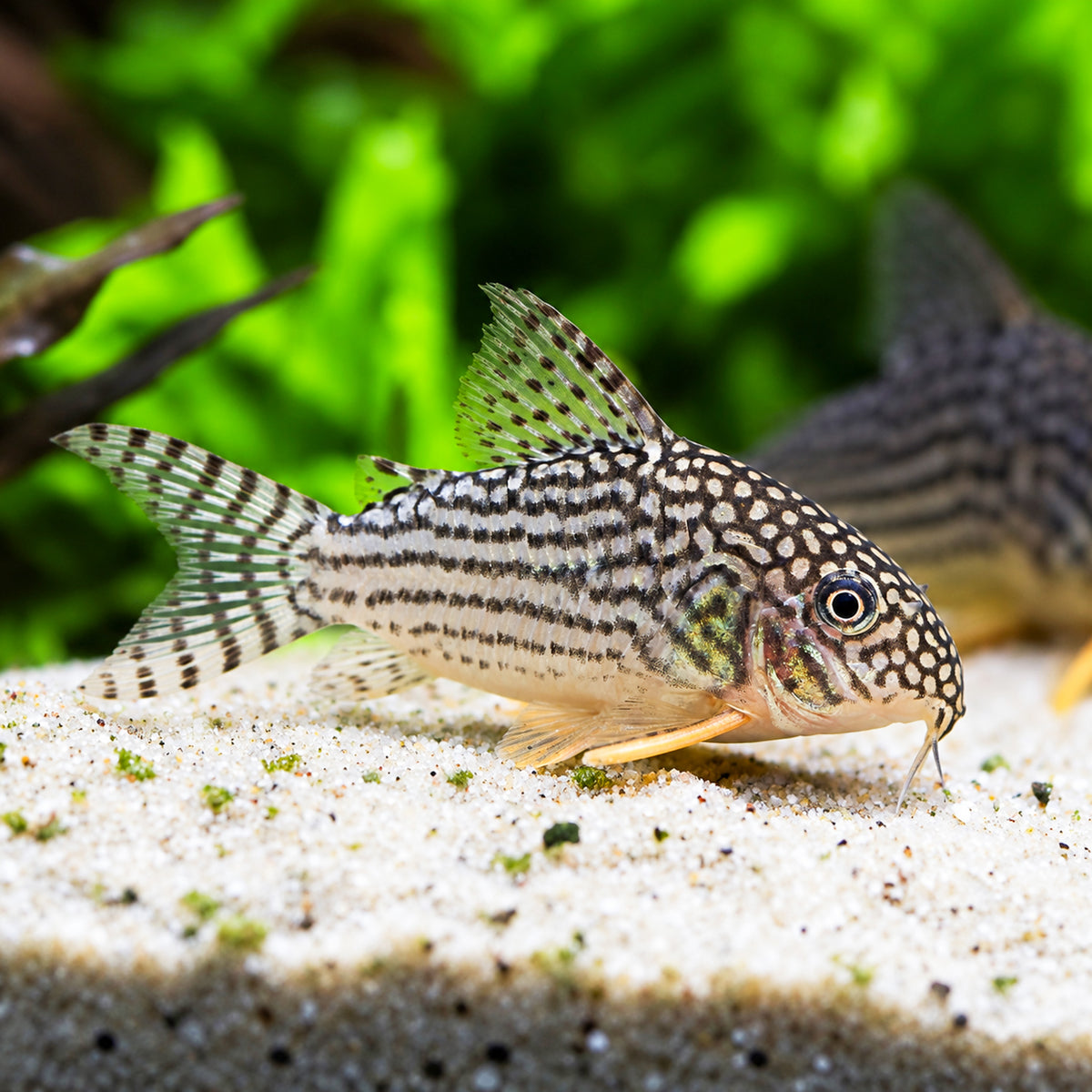
The Sterbai Cory Catfish (Corydoras sterbai), also known as Sterba's Cory, is a peaceful freshwater bottom-dwelling catfish known for its striking white-spotted head, dark body pattern, and bright orange pectoral fins. Sterbai Corys tolerate warmer aquarium temperatures than many commonly kept Cory species, making them a popular choice for warm community aquariums. They are social fish and should be kept in groups of 6 or more.
The Sterbai Cory Catfish (Corydoras sterbai) is one of the most distinctive and popular Cory catfish in the freshwater aquarium hobby. Its dark body is covered with contrasting cream-to-white spots and markings, while its orange pectoral fins add a splash of color that immediately separates it from many other Cory species.
Also commonly called Sterba's Cory or Sterbai Corydoras, this peaceful South American catfish spends much of its time exploring the bottom of the aquarium with other members of its group. Its attractive pattern, manageable adult size, social personality, and tolerance of warmer water make it an excellent choice for many planted and peaceful freshwater community aquariums.
Taxonomy note: This species has traditionally been known throughout the aquarium trade as Corydoras sterbai. Under newer scientific classification, the accepted combination is Hoplisoma sterbai. Both names refer to the fish commonly sold as the Sterbai Cory Catfish.
Sterbai Cory Catfish Care Information
| Care Requirement | Sterbai Cory Information |
|---|---|
| Common Name | Sterbai Cory, Sterbai Cory Catfish, Sterba's Cory |
| Scientific Name | Corydoras sterbai / Hoplisoma sterbai |
| Adult Size | Approximately 2.5–2.7 inches |
| Temperature | 75–82°F (24–28°C) |
| pH Range | 6.0–7.6 |
| Minimum Tank Size | 20+ Gallons Recommended |
| Recommended Group Size | 6+ Recommended |
| Temperament | Peaceful & Social |
| Diet | Omnivore |
| Tank Level | Bottom Dweller |
| Care Level | Beginner-Friendly |
| Origin | Upper Rio Guaporé Basin, Brazil & Bolivia |
What Does a Sterbai Cory Catfish Look Like?
The Sterbai Cory Catfish has one of the most recognizable patterns among commonly kept Cory species. Its head and upper body have a dark base covered with numerous cream-to-white spots and irregular markings.
Farther down the body, the markings become more reticulated and patterned, creating a striking contrast. One of the species' most recognizable features is the orange coloration on the pectoral fins, which becomes especially noticeable on healthy adult fish.
The combination of spotted markings and orange fins gives Corydoras sterbai a distinctive appearance that stands out in planted and natural-style aquariums.
Why Are Sterbai Corys Popular for Warmer Aquariums?
One characteristic that separates the Sterbai Cory from many other popular Cory catfish is its ability to thrive at relatively warm aquarium temperatures. A general aquarium range of approximately 75–82°F (24–28°C) makes this species suitable for community setups maintained warmer than the ideal range for cooler-water Cory species.
Sterbai Corys are one of the better-known Cory species for warmer freshwater community aquariums. Always make sure every species in the aquarium has overlapping temperature, water-quality, and temperament requirements rather than choosing tank mates based only on temperature.
Sterbai Cory Behavior & Group Size
Sterbai Corys are peaceful, social bottom-dwelling fish that should not be kept alone. We recommend maintaining at least 6 Sterbai Cory Catfish together.
When maintained in a proper group, they can often be seen exploring the substrate, searching for food, resting near one another, and moving together around the lower portion of the aquarium. Larger groups may display even more natural and confident behavior when aquarium size and filtration allow.
Sterbai Corys may occasionally dart to the water surface to gulp atmospheric air before quickly returning to the bottom. Occasional surface visits are a normal behavior for Cory-type catfish.
Ideal Aquarium Setup for Sterbai Corydoras
A 20-gallon or larger freshwater aquarium provides a practical starting point for a proper school of Sterbai Corys. Because they spend much of their time near the aquarium floor, horizontal bottom space is especially valuable.
A soft sand substrate or smooth fine gravel is recommended. Sterbai Corys use sensitive barbels around the mouth to search the substrate for food, so sharp, abrasive, or poorly maintained substrate should be avoided.
Plants, driftwood, smooth rocks, shaded areas, and leaf litter can help create a comfortable natural-looking environment while still leaving open areas of substrate for the group to explore and forage.
Sterbai Cory Water Parameters
Sterbai Cory Catfish generally do well at temperatures around 75–82°F (24–28°C) with a pH of approximately 6.0–7.6.
Stable water quality is more important than constantly adjusting the aquarium to reach one exact number. Keep Sterbai Corys in a fully cycled aquarium with appropriate filtration, good oxygenation, and regular water changes.
Because Cory catfish spend significant amounts of time in direct contact with the substrate, keeping the aquarium floor clean is also an important part of long-term care.
What Do Sterbai Cory Catfish Eat?
Sterbai Corys are omnivores and should receive a varied, nutritious diet formulated for bottom-dwelling fish. High-quality sinking pellets or tablets can be used as staple foods.
Their diet can also be supplemented with appropriately sized frozen or live foods such as brine shrimp, daphnia, bloodworms, and similar protein-rich foods.
Sterbai Cory Tank Mates
The peaceful temperament of the Sterbai Cory Catfish makes it suitable for many freshwater community aquariums. Tank mates should be peaceful and comfortable within similar warm-water conditions.
Potential tank mates may include peaceful tetras, rasboras, peaceful gouramis, compatible dwarf cichlids, other suitable Cory species, and other non-aggressive freshwater community fish.
Sterbai Corys are also frequently considered for warmer community aquariums because they tolerate temperatures higher than many commonly kept Cory species. However, compatibility should always be based on the complete care requirements of every species in the aquarium.
Why Choose Sterbai Cory Catfish?
- Beautiful spotted black-and-cream pattern
- Bright orange pectoral fins
- Peaceful temperament for community aquariums
- Tolerates warmer temperatures than many popular Cory species
- Active and entertaining bottom-dwelling behavior
- Excellent choice for planted freshwater aquariums
- Social behavior when maintained in a proper group
- Suitable for both newer and experienced freshwater fish keepers
Before Buying Sterbai Cory Catfish
Sterbai Corys are social fish and should not be kept alone. Plan to keep 6 or more and make sure your aquarium is fully cycled before introducing them. A soft substrate, peaceful tank mates, stable warm water, clean aquarium floor, and enough bottom space will help create a suitable long-term environment for your Sterbai Cory group.
Sterbai Cory Catfish FAQ
What is a Sterbai Cory Catfish?
The Sterbai Cory is a peaceful South American Cory catfish traditionally known as Corydoras sterbai. It is recognized by its contrasting spotted pattern and distinctive orange coloration on the pectoral fins.
How big do Sterbai Cory Catfish get?
Adult Sterbai Cory Catfish can reach approximately 2.5–2.7 inches, although individual size can vary based on genetics, sex, diet, and aquarium conditions.
How many Sterbai Corys should be kept together?
Sterbai Corys should be kept in groups of at least 6 fish. They are social catfish and generally become more confident and active when maintained with an appropriate group.
What temperature is best for Sterbai Corys?
A commonly recommended aquarium temperature range for Sterbai Corys is approximately 75–82°F (24–28°C). Their tolerance of warmer water is one reason they are popular in warm freshwater community aquariums.
Are Sterbai Cory Catfish peaceful?
Yes. Sterbai Corys are generally very peaceful and are well suited to freshwater community aquariums containing other non-aggressive species with compatible water requirements.
Are Sterbai Corys good for warm-water aquariums?
Yes. Sterbai Corys are one of the better-known Cory species for warmer freshwater aquariums because they can be maintained at temperatures around 75–82°F. Tank mates should still be selected based on matching temperature, temperament, tank size, and overall water requirements.
What do Sterbai Cory Catfish eat?
Sterbai Corys are omnivores. Feed a varied diet that includes quality sinking pellets or tablets supplemented with appropriately sized foods such as brine shrimp, daphnia, and bloodworms.
Is Corydoras sterbai the same as Hoplisoma sterbai?
Yes. This species has traditionally been known as Corydoras sterbai and is still widely sold under that name. Under newer scientific classification, the species is placed in the genus Hoplisoma and is recognized as Hoplisoma sterbai.
Do Sterbai Corys clean the aquarium?
Sterbai Corys naturally forage for food along the aquarium floor, but they should not be considered a replacement for aquarium maintenance. They require their own nutritious sinking foods along with regular water changes and substrate cleaning.
Sterbai Cory Catfish at Tropicflow Aquatic
Add beautiful pattern, warm orange accents, and peaceful activity to your freshwater aquarium with the Sterbai Cory Catfish. With their distinctive spotted coloration, social personality, and ability to thrive in warmer community aquariums, Corydoras sterbai are an excellent choice for planted tanks and peaceful freshwater communities.

Customer Review


