


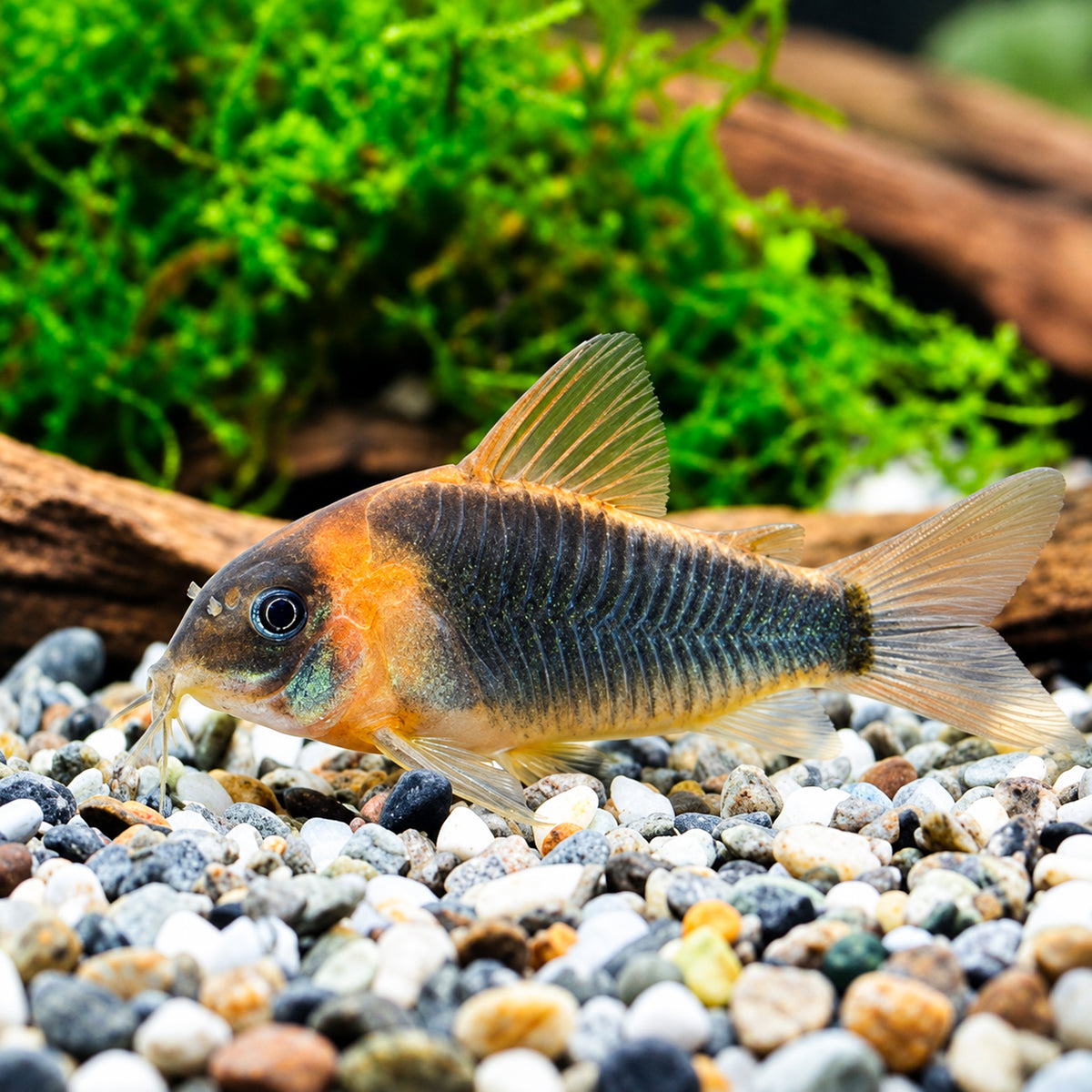
Eques Cory Catfish – Osteogaster Eques
Eques Cory Catfish – Osteogaster Eques
Couldn't load pickup availability
Quick Care
Essential care information at a glance
What Fish Will I Receive?
What Fish Will I Receive?
Photos represent the species and typical appearance of the fish you will receive. Because Corydoras are living animals, individual size, coloration, markings, and pattern may vary naturally from fish to fish.
Why You'll Love Panda Cory Catfish
Why You'll Love Panda Cory Catfish
✓ Peaceful community fish
✓ Active bottom-dwelling behavior
✓ Best enjoyed in social groups
✓ Excellent for planted aquariums
✓ Unique black-and-cream panda markings
✓ Compatible with many peaceful tropical fish
Healthy, Active Corydoras
Healthy, Active Corydoras
Every Corydoras offered by Tropicflow Aquatic is selected for healthy body condition, active behavior, clear eyes, intact barbels and fins, and normal swimming behavior before shipping.
Best Substrate for Corydoras
Best Substrate for Corydoras
Fine sand or another smooth, non-abrasive substrate is recommended. Corydoras spend much of their time searching through the substrate with their sensitive barbels.
Acclimation Directions
Acclimation Directions
1 — Open & Inspect
Check your fish immediately after delivery.
2 — Temperature Acclimation
Float the closed bag for approximately 15–20 minutes.
3 — Gradually Introduce Tank Water
Slowly add small amounts of aquarium water.
4 — Transfer the Fish
Gently move the Cory into the aquarium without pouring shipping water into the tank.
Keep aquarium lights low during the first several hours and allow the fish time to settle.
Water Parameters
Water Parameters
- Temperature: 68-77F
- pH: 6.0 - 7.5
- GH: 2-12 dGH
- Ammonia: 0 ppm
- Nitrate: 0 ppm
- Nitrate: Keep Low
- Water Flow: Gental-moderate
- Oxygenation: Good
Stable water is more important than chasing an exact number. Avoid sudden changes in temperature, pH, or hardness.
Flat Rate Shipping As Low As $25
Flat Rate Shipping As Low As $25
At Tropicflow, we strive to make the shipping process as affordable and convenient as possible for our customers. Our flat rate shipping starts as low as $25, and the more fish you purchase, the more you save on shipping fees. We encourage our customers to combine as many fish as possible in each order to take advantage of these cost-saving opportunities.
The Bandit Cory Catfish (Corydoras metae), also known as the Masked Cory or Bandit Cory, is a peaceful freshwater bottom-dwelling catfish known for its distinctive dark eye mask and bold black marking extending along the back toward the tail. Growing to around 2 inches, Bandit Corys are best kept in groups of 6 or more in a peaceful community aquarium with soft substrate, clean water, and plenty of bottom space to explore.
The Bandit Cory Catfish (Corydoras metae) is an attractive South American Cory catfish recognized by the dark band running across its eyes, giving the fish the masked or “bandit” appearance that inspired its common name.
Also known as the Bandit Cory, Masked Cory, or Meta Corydoras, this species combines bold black-and-cream markings with the peaceful, social personality Cory catfish are known for. Its manageable adult size makes it an excellent choice for planted tanks and peaceful freshwater community aquariums.
Taxonomy note: This species has traditionally been known throughout the aquarium trade as Corydoras metae. Under newer scientific classification, the accepted combination is Hoplisoma metae. Both names refer to the fish commonly sold as the Bandit Cory Catfish.
Bandit Cory Catfish Care Information
| Care Requirement | Bandit Cory Information |
|---|---|
| Common Name | Bandit Cory, Bandit Cory Catfish, Masked Cory |
| Scientific Name | Corydoras metae / Hoplisoma metae |
| Adult Size | Approximately 2 inches |
| Temperature | 68–79°F (20–26°C) |
| pH Range | 6.0–7.5 |
| Minimum Tank Size | 20+ Gallons Recommended |
| Recommended Group Size | 6+ Recommended |
| Temperament | Peaceful & Social |
| Diet | Omnivore |
| Tank Level | Bottom Dweller |
| Care Level | Beginner-Friendly |
| Origin | Río Meta Basin, Colombia |
What Does a Bandit Cory Catfish Look Like?
The Bandit Cory Catfish has a pale cream, beige, or light silver body highlighted by bold dark markings. Its most recognizable feature is the black band that crosses the eyes, creating the distinctive bandit-mask appearance.
Another dark marking begins near the dorsal area and extends backward along the upper portion of the body toward the tail. The strong contrast between the pale body and dark markings makes Corydoras metae especially attractive in planted aquariums.
Their rounded armored body, small barbels, and active bottom-foraging behavior give them the classic Cory catfish appearance while the bold mask makes this species easy to recognize.
Why Is It Called a Bandit Cory?
The common name Bandit Cory comes from the distinctive dark band running across the fish's eyes. This black facial marking resembles a small mask and gives the fish its characteristic “bandit” appearance.
Combined with the darker marking across the upper body, the eye mask creates one of the most recognizable patterns among smaller Cory-type catfish.
The bold black eye mask is the signature feature of the Bandit Cory. Individual pattern intensity may vary slightly, but healthy fish generally display strong contrast between the pale body and dark facial and dorsal markings.
Bandit Cory Behavior & Group Size
Bandit Corys are peaceful, social bottom-dwelling fish and should not be kept alone. We recommend maintaining at least 6 Bandit Cory Catfish together.
In a proper group, they can often be seen exploring the substrate together, searching for food, resting near one another, and moving around the lower portion of the aquarium as a loose school.
Larger groups may display more confident and natural social behavior when aquarium size, filtration, and available bottom space allow.
Like other Cory catfish, Bandit Corys may occasionally swim rapidly to the surface to take a gulp of atmospheric air before returning to the aquarium floor. Occasional surface visits are a normal part of Cory behavior.
Ideal Aquarium Setup for Bandit Corydoras
A 20-gallon or larger freshwater aquarium provides a practical starting point for a proper group of Bandit Cory Catfish. Because these fish spend much of their time near the aquarium floor, horizontal bottom space is especially important.
A soft sand substrate or smooth fine gravel is recommended. Bandit Corys use sensitive barbels around their mouths to search through the substrate for food, so sharp or abrasive materials should be avoided.
Live plants, driftwood, smooth rocks, shaded areas, and leaf litter can create a comfortable natural-style environment while leaving open areas of substrate for the group to explore and forage.
Bandit Cory Water Parameters
Bandit Cory Catfish generally do well at temperatures around 68–79°F (20–26°C) with a pH of approximately 6.0–7.5.
More important than constantly adjusting the aquarium to reach an exact number is maintaining clean and stable water conditions. Keep Bandit Corys in a fully cycled aquarium with appropriate filtration, good oxygenation, and regular water changes.
Ammonia and nitrite should remain at zero, and sudden changes in temperature or water chemistry should be avoided. Keeping the substrate clean is especially important because Cory catfish spend significant amounts of time in direct contact with the aquarium floor.
What Do Bandit Cory Catfish Eat?
Bandit Corys are omnivorous foragers and should receive a varied, nutritious diet formulated for bottom-dwelling freshwater fish. High-quality sinking pellets, tablets, or wafers can form the foundation of their aquarium diet.
Their diet can also be supplemented with appropriately sized frozen or live foods such as bloodworms, brine shrimp, daphnia, Tubifex, and other suitable foods.
Bandit Cory Tank Mates
The peaceful temperament of the Bandit Cory Catfish makes it suitable for many freshwater community aquariums. Tank mates should be peaceful and comfortable within similar temperature and water conditions.
Potential tank mates may include peaceful tetras, rasboras, guppies, peaceful gouramis, compatible dwarf cichlids, other suitable Cory catfish, and other non-aggressive freshwater community species.
Avoid large predatory fish and aggressive tank mates that may chase, injure, intimidate, or prevent the Bandit Corys from feeding comfortably.
Why Choose Bandit Cory Catfish?
- Distinctive black bandit-style eye mask
- Bold black-and-cream body pattern
- Peaceful temperament for community aquariums
- Manageable adult size of around 2 inches
- Active and entertaining bottom-dwelling behavior
- Excellent choice for planted freshwater aquariums
- Social behavior when maintained in a proper group
- Unique alternative to more commonly kept Cory species
Before Buying Bandit Cory Catfish
Bandit Corys are social fish and should not be kept alone. Plan to keep 6 or more and make sure your aquarium is fully cycled before introducing them. A soft substrate, peaceful tank mates, stable water conditions, clean aquarium floor, and enough bottom space will help create a suitable long-term environment for your Bandit Cory group.
Bandit Cory Catfish FAQ
What is a Bandit Cory Catfish?
The Bandit Cory is a peaceful South American freshwater catfish traditionally known as Corydoras metae. It is recognized by the dark mask across its eyes and the bold dark marking extending along the upper portion of its body.
Why is Corydoras metae called the Bandit Cory?
The common name comes from the distinctive dark band across the eyes. This facial marking resembles a small mask, giving Corydoras metae its recognizable “bandit” appearance.
How big do Bandit Cory Catfish get?
Adult Bandit Cory Catfish generally reach approximately 2 inches, making them a manageable choice for many peaceful freshwater community aquariums.
How many Bandit Corys should be kept together?
Keep Bandit Corys in a group of at least 6 fish. They are social catfish and generally become more active and confident when maintained with a proper group.
What temperature is best for Bandit Corys?
A general recommended aquarium temperature range for Bandit Cory Catfish is approximately 68–79°F (20–26°C). Choose tank mates with compatible temperature requirements.
Are Bandit Cory Catfish peaceful?
Yes. Bandit Cory Catfish are generally very peaceful and are well suited to freshwater community aquariums containing other non-aggressive species with compatible care requirements.
What do Bandit Cory Catfish eat?
Bandit Corys are omnivorous foragers. Feed a varied diet containing high-quality sinking foods supplemented with appropriately sized frozen or live foods such as bloodworms, brine shrimp, daphnia, and Tubifex.
Is Corydoras metae the same as Hoplisoma metae?
Yes. The Bandit Cory has traditionally been known as Corydoras metae and is still widely sold under that name. Under newer scientific classification, the species is placed in the genus Hoplisoma and is recognized as Hoplisoma metae.
Where do Bandit Cory Catfish come from?
Bandit Corys are native to the upper Río Meta basin in Colombia, part of the larger Orinoco drainage in northern South America.
Do Bandit Corys clean the aquarium?
Bandit Corys naturally forage along the aquarium floor for food, but they should not be considered a replacement for aquarium maintenance. They need their own nutritious diet along with regular water changes and substrate cleaning.
Bandit Cory Catfish at Tropicflow Aquatic
Add bold markings and peaceful activity to the bottom of your freshwater aquarium with the Bandit Cory Catfish. With their signature black eye mask, attractive cream-and-black pattern, social personality, and active foraging behavior, Corydoras metae are an excellent choice for planted tanks and peaceful freshwater community aquariums.


Customer Review


