


CW005 Gold-Bridled Cory Catfish – Corydoras Aurofrenatus
CW005 Gold-Bridled Cory Catfish – Corydoras Aurofrenatus
Couldn't load pickup availability
Quick Care
Essential care information at a glance
What Fish Will I Receive?
What Fish Will I Receive?
Photos represent the species and typical appearance of the fish you will receive. Because Corydoras are living animals, individual size, coloration, markings, and pattern may vary naturally from fish to fish.
Why You'll Love Panda Cory Catfish
Why You'll Love Panda Cory Catfish
✓ Peaceful community fish
✓ Active bottom-dwelling behavior
✓ Best enjoyed in social groups
✓ Excellent for planted aquariums
✓ Unique black-and-cream panda markings
✓ Compatible with many peaceful tropical fish
Healthy, Active Corydoras
Healthy, Active Corydoras
Every Corydoras offered by Tropicflow Aquatic is selected for healthy body condition, active behavior, clear eyes, intact barbels and fins, and normal swimming behavior before shipping.
Best Substrate for Corydoras
Best Substrate for Corydoras
Fine sand or another smooth, non-abrasive substrate is recommended. Corydoras spend much of their time searching through the substrate with their sensitive barbels.
Acclimation Directions
Acclimation Directions
1 — Open & Inspect
Check your fish immediately after delivery.
2 — Temperature Acclimation
Float the closed bag for approximately 15–20 minutes.
3 — Gradually Introduce Tank Water
Slowly add small amounts of aquarium water.
4 — Transfer the Fish
Gently move the Cory into the aquarium without pouring shipping water into the tank.
Keep aquarium lights low during the first several hours and allow the fish time to settle.
Water Parameters
Water Parameters
- Temperature: 68-77F
- pH: 6.0 - 7.5
- GH: 2-12 dGH
- Ammonia: 0 ppm
- Nitrate: 0 ppm
- Nitrate: Keep Low
- Water Flow: Gental-moderate
- Oxygenation: Good
Stable water is more important than chasing an exact number. Avoid sudden changes in temperature, pH, or hardness.
Flat Rate Shipping As Low As $25
Flat Rate Shipping As Low As $25
At Tropicflow, we strive to make the shipping process as affordable and convenient as possible for our customers. Our flat rate shipping starts as low as $25, and the more fish you purchase, the more you save on shipping fees. We encourage our customers to combine as many fish as possible in each order to take advantage of these cost-saving opportunities.
The CW005 Gold-Bridled Cory Catfish (Corydoras aurofrenatus) is a distinctive long-snouted Cory from the Paraguay River basin. It is best known for its elongated saddle-shaped snout, pale yellow-to-silver body, dark flank patches, banded tail, and the golden-yellow facial coloration that inspired the name Gold-Bridled Cory. Adults reach approximately 2–2.25 inches and should be maintained in groups of 6 or more over fine sand in a mature freshwater aquarium with clean, stable water and compatible tank mates.
The CW005 Gold-Bridled Cory Catfish (Corydoras aurofrenatus) is an unusual South American armored catfish that stands apart from many familiar Cory species because of its noticeably longer, more pointed snout.
Also known as the Gold-Bridled Cory, Goldhead Cory, CW005 Cory, or historically under the name Corydoras ellisae, this species belongs to the long-snouted lineage of true Corydoras.
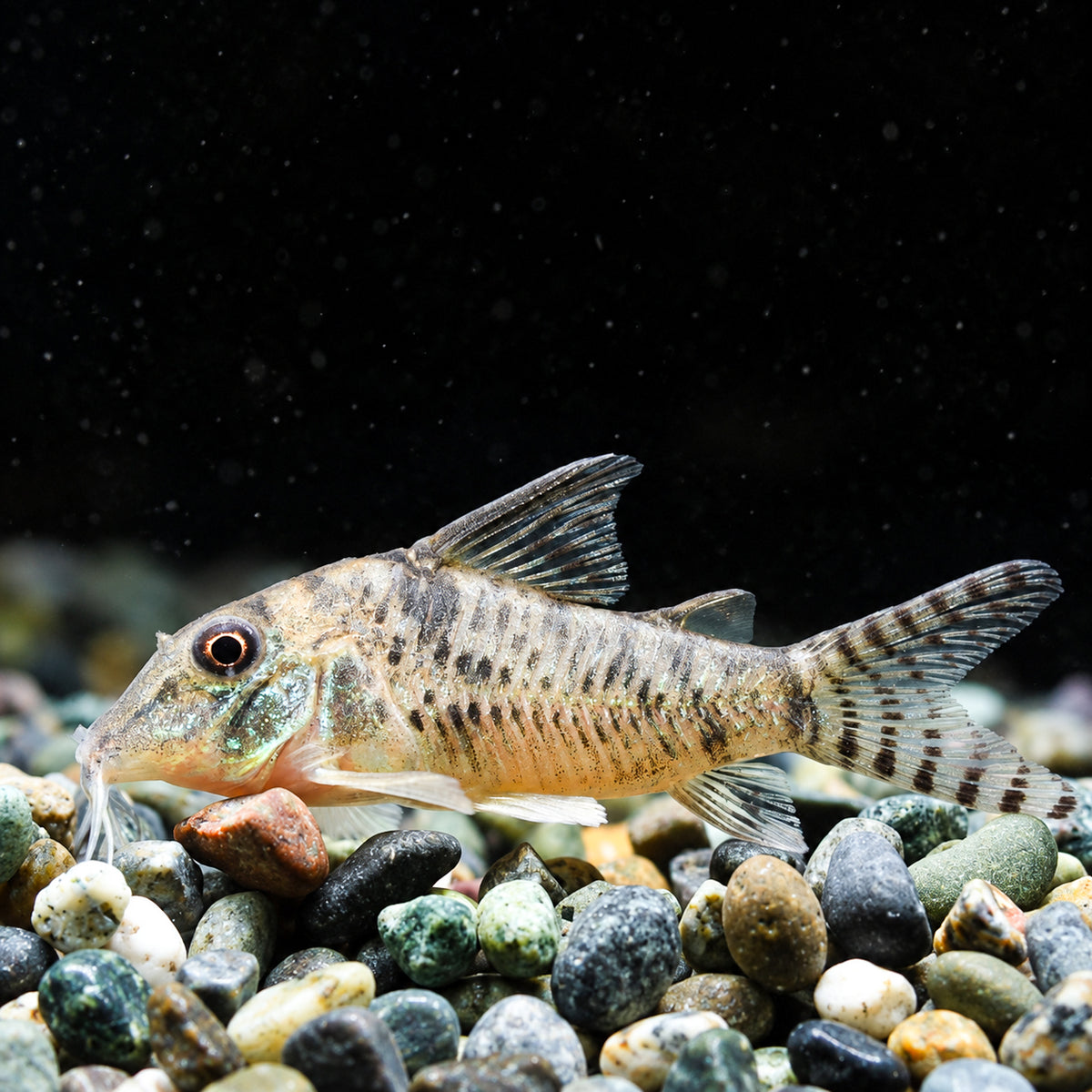
Its body is usually pale cream, yellowish, silver, or light brown with several dark patches along the sides. Live fish may also display attractive greenish-yellow iridescence, while the caudal fin can develop multiple narrow dark bars.
The elongated snout is more than a visual feature. Gold-Bridled Corys use it to probe and sift through soft substrate while searching for small edible organisms, making fine sand especially important for natural aquarium behavior.
Taxonomy note: Unlike many short-snouted Cory species that were moved into genera such as Hoplisoma or Osteogaster during the modern Corydoradinae revision, this species belongs to Lineage 1 and remains in the genus Corydoras. Its accepted scientific name remains Corydoras aurofrenatus.
CW005 Gold-Bridled Cory Catfish Care Information
| Care Requirement | CW005 Gold-Bridled Cory Information |
|---|---|
| Common Name | Gold-Bridled Cory, Goldhead Cory, CW005 Cory |
| Scientific Name | Corydoras aurofrenatus |
| CW Number | CW005 / CW5 |
| Synonym | Corydoras ellisae |
| Body Type | Long / Saddle-Snouted Cory |
| Adult Size | Approximately 2–2.25 inches |
| Temperature | 72–79°F (22–26°C) |
| pH Range | 6.0–8.0 |
| Water Hardness | Approximately 2–15 dGH for General Aquarium Care |
| Recommended Tank Size | 20+ Gallons Recommended |
| Recommended Group Size | 6+ Recommended |
| Temperament | Generally Peaceful; Can Be More Assertive Than Short-Snouted Corys |
| Diet | Omnivore / Benthic Forager |
| Tank Level | Bottom Dweller |
| Care Level | Intermediate |
| Origin | Paraguay River Basin — Brazil & Paraguay |
What Does a CW005 Gold-Bridled Cory Look Like?
The Gold-Bridled Cory has a noticeably elongated, pointed snout that immediately separates it from short-faced species such as Panda, Sterbai, or Bronze Corys.
The base body color is generally pale yellow, cream, brownish-yellow, or silver, with a darker upper head and snout.
Along the middle of the body are usually two or three dark brown-to-black patches. The first appears below the dorsal-fin region, the second below the adipose-fin region, and a third smaller or more diffuse marking may occur near the base of the tail.
The caudal fin can display multiple narrow transverse dark bars, while healthy live specimens may develop subtle greenish-yellow iridescence over the lighter base color.
Why Is Corydoras Aurofrenatus Called the Gold-Bridled Cory?
The scientific name aurofrenatus is associated with the Latin words for gold and bridled.
The name refers to the yellow or golden coloration across the snout and head region, historically described as a broad yellow band across the snout.
This facial coloration, combined with the elongated snout, inspired the aquarium names Gold-Bridled Cory and Goldhead Cory.
Look for the combination of a long pointed snout, yellow-gold head coloration, two or three dark flank patches, and a finely banded tail. This combination makes Corydoras aurofrenatus very different from most common short-snouted aquarium Corys.
What Makes CW005 a Long-Snouted Cory?
CW005 belongs to the classic long-snouted or saddle-snouted Corydoras lineage.
Rather than having the short rounded head seen in many popular Corys, Corydoras aurofrenatus has a noticeably longer and more pointed facial profile.
This shape is associated with a probing style of feeding. The fish can push its snout into fine substrate while searching for small worms, insect larvae, crustaceans, and other edible material.
For this reason, fine sand is especially valuable for CW005. Coarse or sharp substrate can interfere with natural probing behavior and may damage sensitive barbels and the snout.
What Does CW005 Mean?
CW005 is a Corydoras World identification number used in the aquarium hobby for this Gold-Bridled Cory form.
Specialist aquarium references now identify CW005 with Corydoras aurofrenatus, allowing the coded hobby designation and formal scientific species name to be used together.
The CW005 number remains useful because many collectors, breeders, and specialty fish keepers continue to search for the fish by its historical identification code.
Is Corydoras Ellisae the Same as Corydoras Aurofrenatus?
Yes. Older aquarium and scientific references may list Corydoras ellisae as a separate species.
However, detailed taxonomic study found no reliable characters that consistently separate C. ellisae from C. aurofrenatus.
A comprehensive 2020 revision of the long-snouted Corydoras from the Río de la Plata system formally corroborated this synonymy.
Corydoras aurofrenatus is the valid senior name, while Corydoras ellisae is treated as a junior synonym.
Why Is Corydoras Aurofrenatus Still a Corydoras?
Recent Cory taxonomy moved many familiar aquarium species out of Corydoras and into genera such as Hoplisoma, Osteogaster, Gastrodermus, and Brochis.
CW005 is different because Corydoras aurofrenatus belongs to Lineage 1, the lineage that contains the type species of the genus Corydoras.
As a result, its scientific name remains Corydoras aurofrenatus.
Where Do Gold-Bridled Cory Catfish Come From?
Corydoras aurofrenatus is associated with the Paraguay River basin.
The species was originally described from Paraguay near Arroyo Trementina, a tributary associated with the Río Aquidabán system.
Modern taxonomic work has verified populations from tributaries of the Río Paraguay in both Paraguay and Brazil.
Published records have also mentioned Argentina and Bolivia, although some of those historical records have not been confirmed through examined voucher specimens.
Natural Habitat of Corydoras Aurofrenatus
Gold-Bridled Corys have been recorded from a variety of freshwater habitats within the Paraguay River system, from relatively small tributary streams to larger river channels.
Documented habitats can include slow-moving or nearly still water with soft clay, sand, and organic material along the bottom.
In an aquarium, the most important feature to reproduce is a soft substrate that allows natural snout-probing behavior.
Fine sand combined with driftwood, roots, live plants, dried leaves, and shaded areas creates an excellent natural-style setup.
CW005 Gold-Bridled Cory Behavior & Group Size
Gold-Bridled Corys are social fish and should be maintained with members of their own species.
Keep at least 6 CW005 Gold-Bridled Corys together. A proper group encourages more natural foraging, social interaction, and confident aquarium behavior.
Long-snouted Cory species can sometimes be slightly more assertive with one another than the familiar short-snouted Corys. Short chasing or minor disputes may occasionally occur, especially around food or during reproductive activity.
They are not predatory community bullies, but providing adequate floor space, visual cover, and multiple feeding areas is recommended.
Like other Corydoradinae catfish, CW005 may occasionally make a rapid trip to the water surface to gulp atmospheric air. Occasional surface visits are normal behavior.
Ideal Aquarium Setup for CW005 Gold-Bridled Cory
A 20-gallon long aquarium or larger provides a practical starting point for a group of six Gold-Bridled Corys.
Horizontal bottom space is important because this species spends much of its time exploring and probing the substrate.
A fine sand substrate is strongly recommended. This is especially important for long-snouted Corys because they naturally insert their snouts into the substrate while searching for food.
Driftwood, smooth stones, roots, dried leaves, and live plants can provide visual cover while open sandy areas give the group plenty of room to forage.
If multiple individuals display territorial or competitive behavior, use wood and plants to break up sight lines and provide multiple feeding areas.
CW005 Gold-Bridled Cory Water Parameters
Gold-Bridled Cory Catfish generally do well at temperatures around 72–79°F (22–26°C).
A practical aquarium pH range is approximately 6.0–8.0, with soft to moderately hard water suitable for most captive maintenance.
More important than continually adjusting water chemistry is providing stable, clean, well-oxygenated conditions.
Keep CW005 in a fully cycled aquarium with effective biological filtration and regular water changes. Ammonia and nitrite should remain at zero.
What Do CW005 Gold-Bridled Cory Catfish Eat?
Corydoras aurofrenatus is an omnivorous benthic forager that naturally searches through the substrate for edible material.
Feed a varied aquarium diet containing:
- High-quality sinking pellets or granules
- Bottom-feeder tablets
- Frozen or live bloodworms
- Blackworms
- Tubifex
- Brine shrimp
- Daphnia
Scattering some food over the sandy bottom encourages the fish to use their natural probing and searching behavior.
CW005 Gold-Bridled Cory Tank Mates
Gold-Bridled Corys can be maintained with carefully selected peaceful freshwater fish that share similar temperature and water requirements.
Potential tank mates may include peaceful tetras, pencilfish, rasboras, smaller barbs, peaceful dwarf cichlids, and other appropriately sized community species.
Because long-snouted Corys can be somewhat more assertive than many short-snouted species, provide adequate space if mixing CW005 with other bottom-dwelling catfish.
Avoid large predatory fish, highly aggressive bottom dwellers, and extremely competitive species that prevent the Cory group from feeding normally.
Male vs. Female CW005 Gold-Bridled Cory
Mature males and females become easier to distinguish once the fish reach adult size.
Males generally remain somewhat smaller and slimmer, reaching approximately 2 inches.
Females may reach around 2.2–2.25 inches and become broader and rounder through the abdomen, especially when viewed from above.
Mature males can also develop specialized structures associated with reproductive condition, but body shape remains the easiest visual difference for most aquarium keepers.
Why Choose CW005 Gold-Bridled Cory Catfish?
- Distinctive long, saddle-shaped snout
- Golden-yellow facial or “bridle” coloration
- Two to three characteristic dark flank patches
- Attractive finely banded caudal fin
- Subtle greenish-yellow iridescence in healthy adults
- Interesting sand-probing feeding behavior
- Historic CW005 collector identification
- True Lineage 1 Corydoras that retains the Corydoras genus
- Excellent specialty species for Cory collectors
Before Buying CW005 Gold-Bridled Cory Catfish
CW005 Gold-Bridled Corys are social long-snouted Corys and should not be kept alone. Plan for 6 or more fish and use fine sand so they can naturally probe the substrate without damaging their snouts or barbels. Introduce them only to a mature, fully cycled aquarium with clean stable water, appropriate floor space, cover, and a varied diet. Because long-snouted Corys can be slightly more assertive than typical short-snouted forms, adequate space and multiple feeding areas are beneficial.
CW005 Gold-Bridled Cory Catfish FAQ
What is a CW005 Gold-Bridled Cory Catfish?
CW005 Gold-Bridled Cory is the aquarium fish identified as Corydoras aurofrenatus, a long-snouted Cory from the Paraguay River basin known for its yellow-gold head coloration, dark flank patches, and finely banded tail.
Is CW005 Corydoras aurofrenatus?
Specialist aquarium references identify CW005 as Corydoras aurofrenatus. The CW005 code remains commonly used by breeders, collectors, and retailers even though the fish already has a formal scientific species name.
Why is it called the Gold-Bridled Cory?
The name refers to the yellow or golden coloration across the snout and head. The species name aurofrenatus combines roots associated with “gold” and “bridled.”
Is Corydoras ellisae the same as Corydoras aurofrenatus?
Yes. Modern taxonomic study treats Corydoras ellisae as a junior synonym of Corydoras aurofrenatus. A detailed 2020 revision confirmed that the two cannot be reliably separated as different species.
Is Corydoras aurofrenatus now a Hoplisoma?
No. Corydoras aurofrenatus belongs to the long-snouted Lineage 1 group and remains in the genus Corydoras. It should not be renamed Hoplisoma aurofrenatus.
How big do CW005 Gold-Bridled Corys get?
Adults generally reach around 2–2.25 inches. Mature females are typically larger and broader-bodied than males.
How many Gold-Bridled Corys should be kept together?
Keep CW005 in a group of at least 6 fish. Social groups encourage more natural foraging and confident behavior.
Does CW005 need a sand substrate?
Fine sand is strongly recommended. CW005 is a long-snouted Cory that naturally probes into the substrate while feeding, so soft sand allows much more natural behavior than sharp or coarse gravel.
What temperature is best for Gold-Bridled Corys?
A practical aquarium temperature range is approximately 72–79°F (22–26°C), with a pH around 6.0–8.0.
Where do CW005 Gold-Bridled Cory Catfish come from?
Corydoras aurofrenatus is native to the Paraguay River basin. Verified scientific records include tributaries in Paraguay and Brazil, with the original type locality near Arroyo Trementina in Paraguay.
Are CW005 Gold-Bridled Corys peaceful?
They are generally suitable with peaceful community fish, although long-snouted Corys can be somewhat more assertive toward members of their own or closely related species than many short-snouted Corys. Provide adequate bottom space and several feeding areas.
What do CW005 Gold-Bridled Cory Catfish eat?
Gold-Bridled Corys are omnivorous benthic foragers. Feed quality sinking pellets, granules, or tablets supplemented with frozen or live foods such as bloodworms, blackworms, Tubifex, brine shrimp, and daphnia.
Do Gold-Bridled Corys clean the aquarium?
No Cory should be treated simply as an aquarium cleaner. CW005 naturally searches the substrate for food but still requires intentional feeding. Regular water changes, substrate maintenance, and normal aquarium cleaning remain necessary.
CW005 Gold-Bridled Cory Catfish at Tropicflow Aquatic
Add a distinctive long-snouted Cory to your freshwater aquarium with the CW005 Gold-Bridled Cory Catfish. With its golden facial coloration, elongated saddle-shaped snout, characteristic dark body patches, banded tail, and fascinating sand-probing behavior, Corydoras aurofrenatus is an excellent specialty choice for Cory enthusiasts and carefully maintained freshwater aquariums.

Customer Review


